
Published on April 5, 2024
Opportunities in Distressed Investing
Distressed investing can be both risky and lucrative. Distressed investing is an investment strategy that involves buying companies, including debt securities and loans, that are experiencing some form of distress at a significant discount under the premise that their value will increase once the distress is identified and resolved. Often, distressed companies are in or near bankruptcy. Distressed investors find opportunities where no one else will, hence their name. However, their prospects, unattractive to most, can yield high returns.
Returns
Distressed investing comes with risks but also substantial rewards. Returns from distressed investing are heavily dependent on the skill of the manager and can vary widely. As of month-end May, Hedge Fund Research’s HFRI ED: Distressed/Restructuring Index (HFRIDSI) reports a one-year total return of 14.66%,%, five-year total return of 49.28%, and 74.74% return after ten years. In distressed investing, “fixer-upper” companies are sought. When distress is detected, distressed investors “swoop in” to acquire the company. Sometimes, these companies are past the Initial Public Offering (IPO) stage and might be taken private in the restructuring process. Investors seek companies that have a viable product, but are currently cash poor, mismanaged, or have some other solvable problem. Investors will acquire the distressed company with the goal of making it viable once more, rather than admit defeat and face liquidation. This process might involve putting a new management team in place, selling off a division, getting out of bad leases or contracts, reworking the capital structure, or creating other options to allow the company to flourish. Given the complexity of situations that distressed investors work in, they must possess highly specialized skills and knowledge in bankruptcy law and proceedings, corporate restructuring, negotiation tactics, and capital structure.
Strategy
There are three common strategies that distressed investors will deploy, depending on how involved they want to be and the risk they are willing to take on. Distressed investors will sometimes utilize both debt and equity. Equity investing in distressed companies is considered riskier than debt investing because, in the event of failure or liquidation, debt positions will be paid out before equity positions. This means that even if the company does fail, investors holding debt positions may still recoup some of their investment whereas equity investors will likely not.
Control is the Goal
The first strategy is the most time consuming. With this strategy, investors seek a controlling interest in the company and spearhead the reorganization process. Given that control is the goal, investors will often utilize debt positions with the goal of converting them to equity. This is often accomplished via the use of convertible bonds, instruments that allow the investor to be, upon maturity, paid in stock rather than repayment in cash. Investors will often identify the fulcrum security, or the debt position that is most likely to be converted to equity, in an effort to gain a block position to further control the company. Upon gaining control of the distressed company, investors will then restructure the company and reap the rewards after it is much healthier. Long term revitalization of the company is the goal, so investors may be slow to exit. This strategy is commonly used by private equity firms and aims for a return between 20% and 25%.
Active Influence
When utilizing the second strategy, investors do not seek to take control of the company, but do want influence it. As such, debt positions are favored. Equity conversion is not generally sought but may occur. The focus for these investors is on immediate reorganization steps and a viable emergence plan. Investors actively work on bankruptcy proceedings and with creditors to find optimal solutions for the debt that the investors hold. Typically, investors utilizing this strategy prefer to exit soon after emergence from bankruptcy or once a suitable plan has been put into place to yield substantial returns. Investors utilizing this strategy typically aim for returns between 15% and 20%.
Passive
The third approach is a more passive one. Investors using this strategy take advantage of the deep discounts being offered on debt while others flee because the company is struggling. These passive investors take no part in the rehabilitation of the company and as such typically yield lower returns than investors using the other two strategies. These investors will typically take on debt positions that others are not willing to take on. They do not seek to have debt converted to equity. This strategy has the shortest time frame, as it is more of a trading approach than investing, so it is more suitable for those looking to make a somewhat quick buck.
Industry Opportunities
Distressed investors need to be careful when selecting companies to invest in. Distressed companies are often in or near Chapter 11 bankruptcy with the intent of exercising corporate and capital restructuring to help resolve issues the company might have. Over the past couple of years, we have seen bankruptcy filings on the rise, and in April alone, Chapter 11 bankruptcy filings amounted to 542, a 40% increase year from January 2023.
Looking back, 2023 saw more bankruptcies than any other year since 2010. One might think that looking to the industry that has seen the most bankruptcies as of late would be a good place to start identifying specific companies, but investors should be wary of this approach. If one sector is seeing a slew of bankruptcies, this could be symptomatic of a larger, unfixable issue within the industry as a whole, so an individual company in that sector might not be repairable in a short time frame. That being said, there are a few industries that are likely to offer distressed investors opportunities in 2024 and 2025.
US bankruptcy filings by year
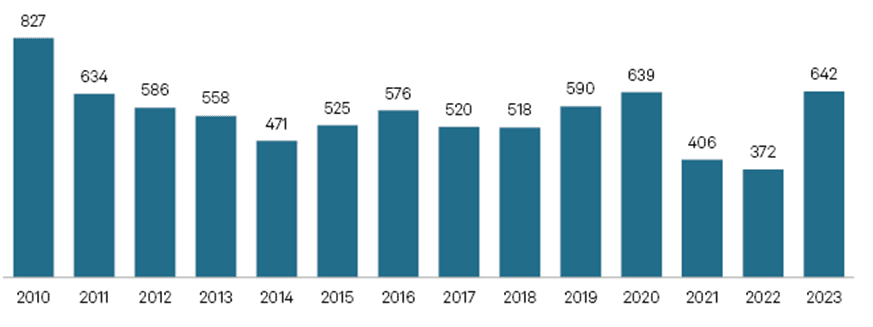
US bankruptcy filings by year
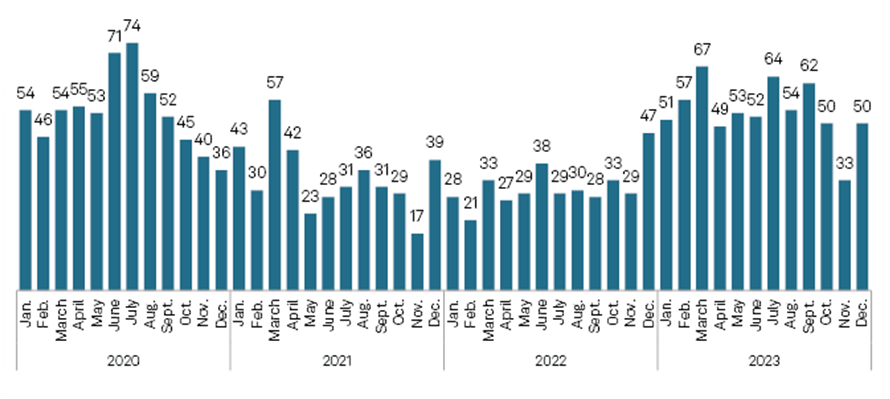
Data compiled Jan. 2, 2024.
Includes S&P Global Market Intelligence-covered US companies that announced a bankruptcy between Jan. 1, 2020, and Dec. 31, 2023.
S&P Global Market Intelligence's bankruptcy coverage is limited to public companies or private companies with public debt where either assets or liabilities at the time of the bankruptcy filing are greater than or equal to $2 million, or private companieswhere either assets or liabilities at the time of the bankruptcy filing are greater than or equal to $10 million. Involuntary bankruptcy filings are also included.
Source: S&P Global Market Intelligence.
© 2024 S&P Global.
Source: SP Global, Jan 2024. "US bankruptcies hit 13-year peak in 2023; 50 new filings in December"
Automotive

The automotive industry has struggled in the last few years. It has experienced supply chain issues, increasing labor costs, and demand for pioneer products that are not yet fully developed, to name just a few of its issues. That is not to say that the industry is too risky to search for potential investments. Supply chain issues are expected to ease, labor costs will level out eventually, and Electronic Vehicles (EV) and infrastructure are making progress. Not to mention, cars are never going away. Demand for cars is still high, and people are looking forward to reliable EVs in an effort to help the environment. This offers distressed investors an opportunity. Given the conditions, we can expect some companies in the automotive industry to become distressed, but with enough up-side potential to draw interest from investors willing to take on some risk and work for a desired reward.
Energy

The energy sector has seen increasing prices over the years, regulatory problems, issues with grid reliability and various lawsuits. Most recently, a number of wildfires have broken out due to failure to maintain infrastructure. For example, Pacific Gas & Electric filed for bankruptcy in 2019 as a result of being found guilty of faulty equipment and negligently starting wildfires in 2017 and 2018. Overall, the energy industry saw a moderate amount of bankruptcies in 2023. There might be issues, but there is also opportunity. The energy industry is not going anywhere and there is a push for more renewable energy sources, which could bring high returns as solutions become more readily available.
Financial Services

Given the confluence of rising rates, the broader macro environment, and some idiosyncratic events over the past couple of years, we have seen events of stress and even distress in the financial services sector. The collapse of FTX in late 2022 marked one of the most significant failures within the cryptocurrency industry, sending shockwaves through digital asset markets and sparking intense regulatory scrutiny. FTX, once a leading cryptocurrency exchange, was brought down by a combination of corporate governance failures and financial mismanagement. The platform struggled with liquidity issues after a wave of customer withdrawals, which revealed that it was insolvent. Investigations found that FTX had misused customer funds and engaged in risky trading practices that ultimately led to its downfall. The crash not only eroded trust in cryptocurrency exchanges, but also highlighted the urgent need for more robust regulatory frameworks in the digital assets sector. Additionally, the collapse of Silicon Valley Bank (SVB) in early 2023 sent shockwaves through the tech and venture capital ecosystems, underscoring the vulnerability of even specialized banks to economic downturns. SVB, which primarily served startups and tech companies, faced a liquidity crisis triggered by a rapid increase in interest rates and significant withdrawals by panicked depositors. Despite attempts to shore up capital, the bank was unable to stabilize, leading to regulatory intervention and takeover. The failure of SVB was mirrored by other regional banks such as Signature Bank and First Republic Bank, which faced similar liquidity and operational challenges.
These collapses raised urgent questions about the adequacy of current regulatory frameworks and risk management protocols, particularly for financial service firms serving niche markets, but also presented an opportunity for distressed debt funds to insert themselves and salvage value.
Healthcare

The healthcare industry had the second most bankruptcies in 2023. This was largely due to labor costs and shortages. However, the world is never going to stop requiring hospitals, boomers are aging rapidly, and nursing is the third most popular college major. People are also living longer, so there has been an increase of nonemergent medical treatments, such as hip replacements and cataract surgeries to improve quality of life. This gives distressed investors an opportunity to swoop in on an independently owned hospital or skilled nursing facility, for example, and reap significant rewards.
Real Estate

While technically a real asset rather than a marketable security, real estate is an obvious choice in the distressed environment. Thanks to COVID and the ability to work remotely, commercial buildings sit nearly empty, and some owners are desperate to be rid of them. This affords distressed investors an opportunity to capture a building, rework it, and make it profitable. While easier said than done thanks to regulatory and planning issues, the rehabbing of commercial buildings to turn them into residential or mixed-use buildings will eventually happen.
Concluding Thoughts
The current macroeconomic environment, characterized by slowing global growth and heightened recession risks in both the U.S. and Europe, presents a compelling opportunity for distressed debt funds. Elevated inflation above the Federal Reserve’s 2% target and prolonged higher interest rates may exacerbate structural labor market issues. The expansion of leveraged credit markets, particularly those with lower ratings, and policy uncertainties are intensifying recession fears, which may create a fertile ground for distressed and special situation investing. An increasing number of bankruptcies and restructurings across various industries provide these funds with ample opportunities to deploy capital. In this type of environment, Distressed debt fund managers that have previously navigated the complexities of market cycles can leverage their expertise and capitalize on sound risk-adjusted opportunities.
Sources:
View the institutional funds on our platform that are positioning themselves to take advantage of distressed debt opportunities.
For financial advisors only.