
Published on January 31, 2025
Navigating Market Turbulence: The Resilience of Equity Market Neutral Strategies
In a world where markets can swing from record highs to crushing lows in the blink of an eye, investors are increasingly turning to strategies that can offer stability amidst chaos.
Understanding Equity Market Neutral
At its core, an equity market neutral strategy seeks to neutralize market risk by balancing long and short equity positions. The objective is to isolate and capture the alpha—the excess return on an investment relative to a benchmark index—while mitigating exposure to broader market movements. In practice, this involves rigorous stock selection, along with quantitative models, fundamental analysis, or a blend of both.
Consider a portfolio manager who identifies undervalued stocks to go long while simultaneously shorting overvalued stocks within the same sector or region. The aim is to profit from the relative price movements of these stocks while shielding the portfolio from systemic market shocks. For instance, in a rising market, gains from long positions are expected to offset losses from short positions, and vice versa in a declining market.
Equity Market Neutral: The Appeal During Volatility
The past two years have been a masterclass in market unpredictability. Geopolitical tensions, supply chain disruptions, and fluctuating monetary policies have created a vortex of uncertainty for investors. The S&P 500, often seen as a barometer of U.S. equity market health, has experienced sharp peaks and troughs, leaving traditional long-only strategies vulnerable.
In contrast, EMN strategies have demonstrated resilience. By design, these strategies are less sensitive to market beta—a measure of volatility relative to the broader market—and can deliver positive returns even in bear markets. This decoupling from market directionality makes them a compelling choice for diversification within a broader portfolio.
Moreover, as central banks around the globe wrestle with inflation through aggressive interest rate hikes, equity valuations have come under pressure. For EMN managers, this environment provides fertile ground for identifying mispriced securities and exploiting relative valuation discrepancies.
Notably, according to a report by BarclayHedge, assets under management in market-neutral hedge funds surpassed $70.1 billion in 2023, reflecting growing investor confidence in these strategies. Additionally, a study from BarclayHedge revealed that equity market neutral funds delivered an average annualized return of 6% over the past decade, outperforming many traditional investment vehicles during volatile periods.
AQR’s Equity Market Neutral Fund, QMNNX
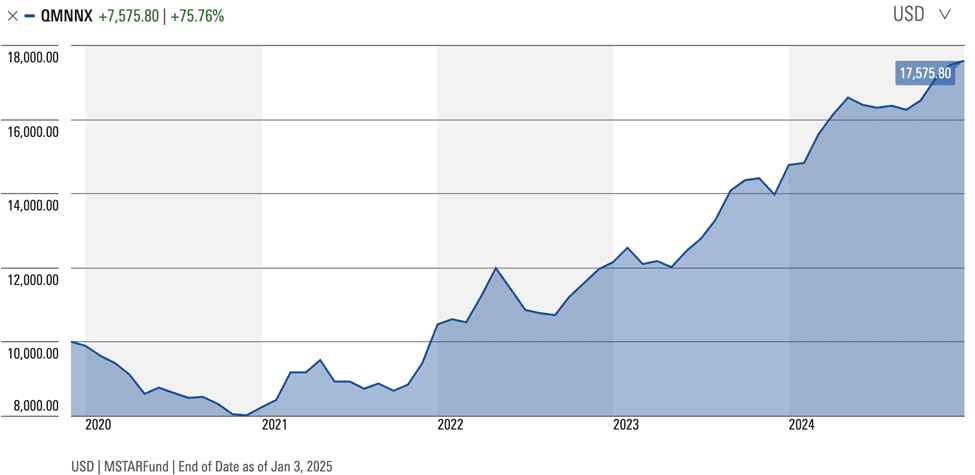
Source: QMNNX – Chart – AQR equity market neutral n | morningstar. (n.d.-a).
Equity Market Neutral: Challenges and Critiques
While EMN strategies have clear advantages, they are not without challenges. Their success hinges on accurate stock selection and precise portfolio construction. Misjudgments in either can erode returns, as the protective balance between long and short positions is disrupted. Additionally, these strategies often rely on leverage to amplify returns, introducing another layer of risk.
Transaction costs and the impact of high-frequency trading also pose hurdles. The frequent rebalancing required to maintain market neutrality can eat into profits, particularly during periods of heightened volatility. Furthermore, a crowded trade environment—where multiple funds target the same opportunities—can diminish the efficacy of alpha generation.
Equity Market Neutral: Role of Technology
The rise of sophisticated data analytics and artificial intelligence (AI) has been a game-changer for EMN strategies. Modern portfolio managers leverage machine learning algorithms to sift through vast datasets, identifying patterns and anomalies that might elude human analysts. This technological edge not only enhances stock selection but also enables dynamic risk management, ensuring portfolios remain market neutral even as conditions shift.
For example, natural language processing tools can parse earnings call transcripts or social media sentiment to glean insights into company performance. Similarly, predictive analytics can forecast sector trends, allowing managers to adjust exposures proactively. These tools, while powerful, necessitate significant investment in infrastructure and expertise, underscoring the importance of scale in this space.
Different Types of Market Neutral Strategies
Equity market neutral (EMN) strategies can vary significantly in their approach, depending on the underlying methodology and objectives. Fundamental EMN strategies rely on deep fundamental analysis to identify mispriced securities based on company-specific metrics, such as earnings, valuation ratios, or industry dynamics. In contrast, statistical arbitrage focuses on quantitative models and historical data patterns to exploit short-term pricing inefficiencies across correlated securities. Another variant includes tail-risk mitigation strategies, which aim to hedge against extreme market events while maintaining a neutral stance. These diverse approaches allow EMN managers to tailor their strategies to specific market conditions and investor objectives, enhancing the adaptability and resilience of the market neutral framework.
Equity Market Neutral: Outlook for 2025 and Beyond
As we step into 2025, the investment landscape remains fraught with uncertainty. The specter of a global economic slowdown looms large, while technological innovation continues to reshape industries and create new opportunities for disruption. In this context, equity market neutral strategies are poised to remain relevant.
The increasing integration of environmental, social, and governance (ESG) criteria into investment decisions presents both challenges and opportunities for EMN managers. Identifying alpha-generating opportunities within the ESG framework will require innovative approaches and deep sector expertise.
Additionally, the shift toward decentralized finance and blockchain technology may open new avenues for arbitrage and mispricing, offering fertile ground for EMN strategies to evolve. However, navigating these uncharted waters will demand agility and a willingness to embrace change.

Equity Market Neutral: Conclusion
In an era where volatility is the norm rather than the exception, equity market neutral strategies can offer a beacon of stability. Their ability to deliver consistent returns, irrespective of market conditions, underscores their enduring appeal. While challenges remain, advancements in technology and the evolving financial landscape provide ample opportunities for innovation.
For investors seeking to diversify their portfolios and mitigate risk, EMN strategies deserve serious consideration. As history has shown, their role in weathering financial storms is not merely theoretical but proven, making them a cornerstone of resilient investing.
Sources:
- Group, B. S. (n.d.). Equity market neutral. BarclayHedge.
- Barclayhedge indices. BarclayHedge. (n.d.).
- Building a better equity market neutral strategy. AQR Capital Management. (n.d.).
- Group, B. S. (n.d.-b). Hedge Fund Industry Assets Under Management. BarclayHedge.
- QMNNX – Chart – AQR equity market neutral n | morningstar. (n.d.-a).
View the equity market neutral hedge fund exposures on our platform.
For financial advisors only.