
Published on February 20, 2024
The Cost of War: Ukraine. Gaza. Houthis.
When VIX spikes, “alternates” will matter again
Someone said that even during the ugliest global conflicts, in most places around the world, there is absolutely nothing going on. To many in the U.S., this is a familiar feeling.
Meanwhile, over in Europe the biggest ground war since WWII continues. Hundreds of thousands are dead and wounded on both sides; over 10 million Ukrainians are refugees.
In Israel, after the worst single-day massacre of Jews since the Holocaust, close to 2 million Palestinians have been pushed to live in camps as Israeli forces seek to eradicate Hamas terrorists from Gaza.
Nearby in the Red Sea, where 15% of the world’s goods1 are shipped, Houthi rebels are attacking cargo ships with drones and missiles as “retaliation” for Israel’s counterattack. Shipping costs are rising fast, and the global dominos are cascading.
The U.S. is indirectly involved in all three conflicts. But here on the ground, you’d never know. Americans are happy that life is finally back to normal after the pandemic. We are shopping, dining, going to concerts. Stocks are trading at record highs, and the VIX “fear index” is scraping the bottom.
The cost of war hasn’t hit us yet. Yet the costs are considerable. Let’s look at some of them.
The Cost of the Russia-Ukraine War
Since Russia invaded in February 2022, the U.S. has provided over $44B in military assistance and related aid to Ukraine, and has just agreed to legislation providing an additional $61B of support.2, 3
Many would agree that this capital could go a long way towards fixing issues at home, such as the migrant crisis at the border or education issues, among countless others – although, it’s important to note that the bulk of the Ukraine aid has stayed right here in the U.S. and gone into the pockets of American workers making ammunition, shells, and guns. Consider also that $40B is less than 5% of the Department of Defense budget ($816B in 2023). So, for a fraction of a single year’s defense spending, the U.S. is indirectly hurting a belligerent adversary’s army, which before the war was considered the world’s 2nd best. (Not anymore; combat showed it’s maybe a distant 3rd after China, maybe.)
The cost of war has extended far beyond the battlefields. It initially caused a big spike in commodity prices, especially wheat. By last fall wheat prices fell back to earth when Russia’s bumper crop replaced Ukraine’s exports.4
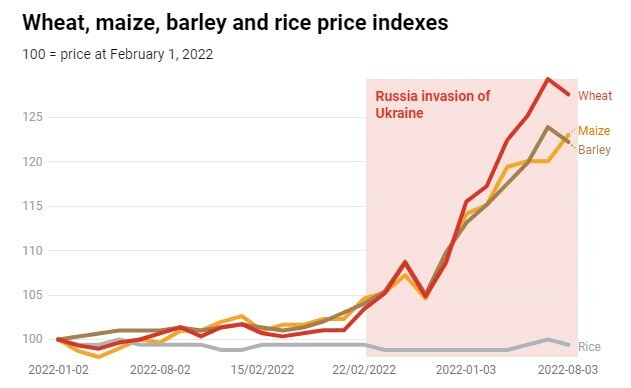
Credit: International Grains Council
The Cost of the Israel-Hamas War
Since the founding of Israel in 1948, the U.S. has been its unwavering supporter. Today, the signs of that support permeate the Israeli military.6 As for the costs, in 2016 the Obama administration signed a record, ten-year, $38B aid agreement with Israel, and last October President Biden asked Congress for $14B in additional aid, and more recently, legislation introduced would provide an additional $14B.3
Additionally, other costs of war remain. Home to global tech marvels like Waze, the navigation app that has redefined how we travel, Israel stands proudly at the technological forefront. The high-tech industry is the lifeblood of the country’s economy, powering an impressive 12% of the workforce and contributing to a significant 18% of its GDP. What’s more, this vibrant sector is the source behind half of Israel’s exports, a testament to the country’s commitment to tech excellence. Unfortunately, as noted by NPR, tens of thousands of Israeli tech workers are reservists who have been called into battle, leading to a contraction in the labor force. Ultimately, the Bank of Israel estimates economic shrinkage of 2% in the final three months of 2023, with the cost of war estimating about $58B.7
That brings us to a related topic: Houthi attacks on cargo ships in the Red Sea.
The Cost of Houthi Rebel Attacks on Cargo Ships
Houthis are an armed group that controls most of Yemen. With close to 20,000 soldiers8, these radicals have made it their open goal to attack any ship in the Red Sea with a connection to Israel. Because the U.S. and Britain support Israel, their ships are the main targets. Not just military ships – cargo vessels, too.
The attacks are starting to cripple global trade. Maritime traffic through the Suez Canal is down 37% compared to a year ago9. Shipping giants Maersk and Hapag-Lloyd are now taking an “extraordinary detour”10 to send cargo some 4,000 miles south, around the southern tip of Africa, adding 20 days of travel. With the value of each ship plus cargo pushing $1B each, you can imagine the extra costs: fuel, crew pay and care, insurance.
Because of all this, the average cost of a shipping container has recently doubled in just one month. In fact, in just one week ending January 18, the shipping cost of a 40-foot container jumped 23% on average; 38% more for the same container sent from China to Los Angeles (chart: NY Times).
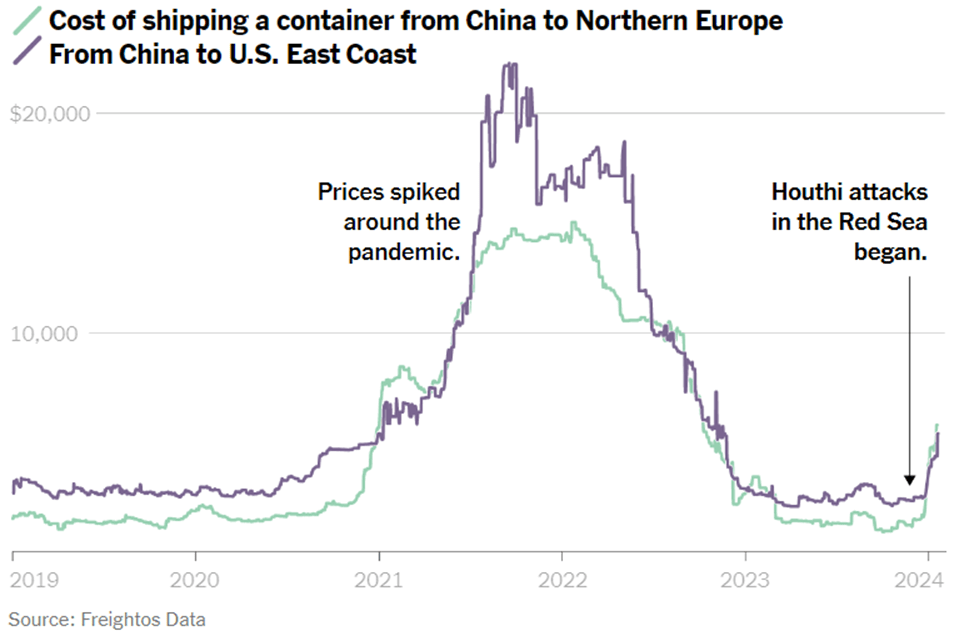
And it doesn’t help that, due to a drought, the authorities on the other side of the globe have restricted the number of ships allowed to pass through another major shipping channel, the Panama Canal.
All this is happening just as inflation here in the U.S. has finally come down from the 40-year high seen two years ago. That spike was caused, in part, by pandemic-induced shipping disruptions. Now JPMorgan Chase expects a 0.7% bump in inflation worldwide11 unless the Houthi rebels are stopped. But stopping them comes at a big cost. While the U.S. is sending its high-tech fighter jets into the region, the Houthis attack with inexpensive drones and missiles.
"We have to become comfortable with uncertainty," says one shipping executive. "No one wants to be, but that's the world we're living in."
"You need to be asking, 'What are some backup plans that I can be putting in place now?
“Should I find alternate routes?”
Meanwhile, the VIX “fear index” didn’t seem to notice
The VIX is trading where it was right before the pandemic in early 2020. A little lower, in fact. There is little fear in the markets (chart: cnbc.com).
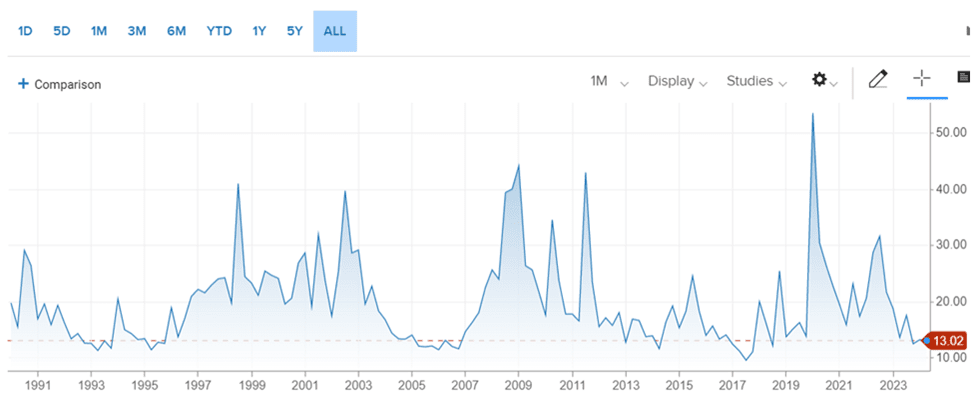
At the same time, U.S. stocks are breaking records, and the yields on the 10-year U.S. Treasuries are comfortably down to around 4%. All of this is a strong indication of complacency in the financial world. But every period of complacency ends, usually abruptly, with a sudden realization of the dangers that have been hiding in plain sight.
That’s when that jolt of uncertainty -- what markets absolutely hate -- comes to the forefront.
Of course, the future is always uncertain. We simply forget about it when we don’t see doomsday headlines for a while. When those headlines return, our collective sense of uncertainty floods back – and so does the need to find those “alternate routes.”
Final Thoughts
There are juxtaposing positions on the US sending hundreds of billions of capital abroad to support endless wars. Some constituents believe this money threatens the fiscal solvency of our country and drags our country down; others believe this is a means to an end. However you slice it, markets don’t seem to be sufficiently pricing in the potential for volatility, which is confusing many investors.
While we are proponents of a balanced portfolio, we also believe there is a myriad of solutions that could address hidden risk. Hedge funds can potentially help navigate uncertainty. In this unprecedented situation, where the cost of war remains uncertain and multiple escalations loom abroad, it is challenging to predict market responses. During times of global distress and heightened uncertainty, investors often gravitate toward sophisticated management strategies, such as global macro funds, aimed at capitalizing on geopolitical and macroeconomic events through strategic trading. Multi-strategy funds can also offer the flexibility to trade across diverse asset classes and exploit unique market events. While investors of varying perspectives are confronted with risks in unpredictable scenarios, such as the ongoing crisis in Ukraine or the Middle East, it behooves one to explore how active managers are positioning themselves amidst persistent uncertainty and compare it against a more traditional passive investment approach.
Sources:
- As Houthi attacks on ships escalate, experts look to COVID supply chain lessons – NPR
- Senate Passes Aid Package – ABC News
- U.S. Security Cooperation with Ukraine – U.S. Department of State
- Wheat prices fall as bumper Russian crop replaces Ukrainian supplies – The Financial Times
- Impacts of the Russian invasion of Ukraine on the global wheat market – Science Direct
- US begins delivering munitions to Israel as the American death toll rises to 11 in Hamas attacks – AP News
- The war in Gaza has taken an economic toll on tech, Israel's most productive sector - NPR
- Iranian and Hezbollah commanders help direct Houthi attacks in Yemen -- Reuters
- Ocean Shipping Rates Surge as Red Sea Attacks Continue – The Wall Steet Journal
- How Houthi Attacks Have Upended Global Shipping – The New York Times
- Red Sea Skirmishes Are Starting to Squeeze Profits and Could Spark More Inflation – The Messenger
Rising volatility caused by these wars is driving demand for uncorrelated strategies.
For financial advisors only.