
Published on November 21, 2024
Commercial Aviation's Prolific Pair: Sky High Stakes
The commercial aviation industry has long been dominated by the duopoly of Boeing and Airbus. With incredibly high barriers to entry, the two have enjoyed a privileged economic status that has led to many decades of success. However, that privileged status has also led to complacency among the pair. Over the past several years, Boeing has made significant missteps, which have put them in a precarious position today. Airbus has seized on those missteps and gained market share but, with the lack of competition, has taken its foot off the gas. While the economic moat among commercial aviation jets has protected Boeing’s and Airbus’s respective core lines of business from competitors for now, their complacency has shown in other areas such as their space businesses, where they have been lapped by disruptors like SpaceX. To protect their duopoly, Boeing and Airbus must embrace their origins, refocus on their core line of business and get back to the engineering excellence that made them great.
High Barriers, Small Club
Barriers to entry in commercial aviation are higher than almost any other industry, leading to the current duopoly of Boeing and Airbus. Designing and manufacturing a commercial jet takes many years and costs tens of billions of dollars. Even if a company takes the R&D plunge and spends the billions necessary to get into the business, success can be quite elusive.1 For example, Bombardier was driven to the brink of bankruptcy when they tried to crack into the industry in the 2000s with their A220 program. After billions invested in R&D and the accumulation of a crushing debt load, they were ultimately bought for pennies on the dollar by Airbus. Aside from the difficulty involved in designing and manufacturing a new aircraft, airlines prefer commonality among their fleet to benefit from economies of scale among their suppliers and maintenance teams which is why Southwest Airlines only flies the Boeing 737.2 While the duopoly status is protected by high barriers to entry and produces significant economic privileges, those privileges can lead to complacency and risk the longer-term outlook of the business.
MAX Impact: America’s Aviation at Stake
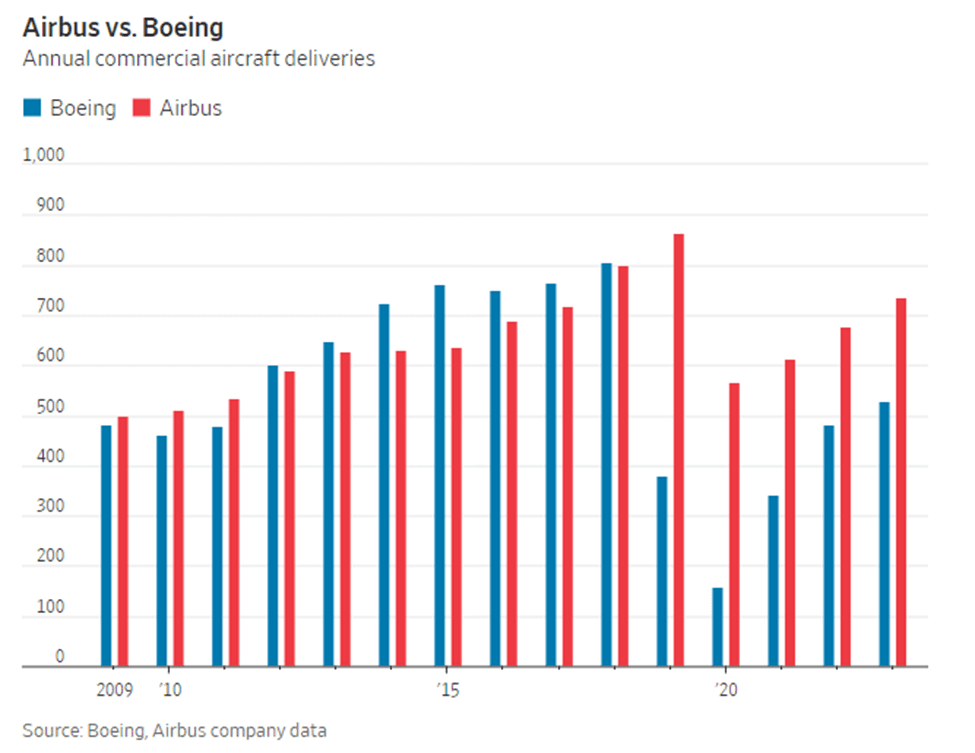
Six years ago, Boeing was flying high as its stock hit a new all-time high. Business was strong, negative headlines were practically non-existent, and there were clear skies ahead. Then, in 2018 a Boeing 737 MAX crashed in Indonesia. Then, a few months later, there was a second crash in Ethiopia which further eroded trust in the company. These crashes led to a grounding of the 737 MAX, cutting Boeing’s 2019 aircraft deliveries in half vs 2018. Then came Covid-19, which took airline travel to a screeching halt and cut Boeing’s 2020 aircraft deliveries in half vs 2019. Since then, Boeing has struggled to get back up to its 2018 aircraft delivery levels. Critics say that the issues that Boeing is facing today are the result of a shift in the 1990s towards short-term profitability over engineering prowess. Many see this shift exemplified by their decision to move headquarters away from their manufacturing hub in Seattle to Chicago and now to Virginia. With the focus on short term profitability, some engineers faced pressure to stay silent about safety concerns, and some even had concerns about the flight-control system that led to their first MAX crash.3
New Year, New Problems
Now, Boeing faces more crises as they recently settled a costly strike among their machinists amid an unprecedented strain on their finances and are dealing with the fallout from the blowout of a panel on a 737 MAX.4 To address their financial woes, Boeing plans to raise $25 Billion through debt and equity offerings which is a good step in the right direction. For longer term realignment, the company must look to what made them great in the past. The best innovators in aerospace such as Boeing of years past, Kelly Johnson and Lockheed Martin, and Elon Musk and SpaceX all have one thing in common: centralized operations. Boeing has become a sprawling corporation all over the world that has lost its focus. To regain their once great status, Boeing needs to divest from their non-core businesses that are hemorrhaging cash and re-prioritize their commercial aviation engineering by centralizing their operations. Otherwise, they will risk the long-term success of the business and face continued loss of market share to Airbus.
Airbus in the Comfort Zone
Airbus has seized on Boeing’s missteps and grown their commercial aviation market share considerably over the past 5 years. Last year, Airbus set a record for incoming orders, adding to an airplane order backlog that would take more than 10 years to clear.4 Further, Airbus has already bounced back from the dip in deliveries due to Covid and is set to hit record production in 2026. With these developments, Airbus has secured its position as the market leader in commercial aviation. However, with the recent lack of competition, Airbus has also had complacency creep in. While analysts suspect a new plane model initiative could be coming in the next few years, it has been roughly 10 years since they last delivered a novel plane. Further, with a decades-long order backlog, some customers have complained of delays while others have noted quality issues with new deliveries. While Airbus has benefited from the lack of competition and barriers to entry protecting its core businesses, its complacency and lack of innovation have increasingly shown in its other lines of business.
Same Sky, Different Story: The SpaceX Warning
Airbus recently announced mass layoffs in their space division and Boeing announced cutting up to 10% of their workforce as they both face rising competitors such as SpaceX in their alternate lines of business. Both companies have failed to innovate and keep up with SpaceX. Airbus CEO Guillaume Faury said they were seeing greater competition from “some disruptive new players, and in particular, one disruptive new player.”6 In fact, SpaceX is set to bring 2 astronauts back to earth after they were stranded in Space due to safety concerns about Boeing’s Starliner vehicle, which was supposed to bring them home.7 Now, Boeing is exploring a sale of its space business altogether.8 While Boeing and Airbus enjoy the privileges of duopolistic status in their core business of commercial aviation, that status is not untouchable, and the troubles faced in their space businesses show what could happen to their commercial aviation lines if they don’t turn things around. To preserve their privileged market status, Boeing and Airbus need to get back to their roots, focus on engineering and innovation and act more like disruptors than an entrenched duopoly.
Conclusion: The Duopoly’s Essential Evolution
Boeing and Airbus have long enjoyed the benefits of their commercial aviation duopoly status. However, that status has led to a push for greater short-term profits and has stifled innovation and long-term growth. While the incredibly high barriers to entry into the commercial aviation industry have protected their core, the duo’s complacency has shown in their other lines of business as they have been lapped by competitors such as SpaceX. To ensure long-term success, Boeing and Airbus need to get back to their roots and focus on engineering world class commercial aircraft. For Boeing, that means recentralizing their operations as much as possible, selling their space business, delivering high quality planes, and developing a roadmap for new models. For Airbus, that means ramping up plane production to work through their order backlog and pouring R&D into their next plane model. To maintain their duopolistic status, Boeing and Airbus need to get back to their engineering roots and start acting more like SpaceX.
Sources:
- Forbes. February 2020. “Airbus Buys Bombardier Out Of Commercial Aviation For $591 Million”
- Simple Flying. September 2019. “Why Does Southwest Only Fly The Boeing 737?”
- Wall Street Journal. October 2024. What Went So Wrong With Boeing?
- Wall Street Journal. November 2024. “Boeing Union Votes to End Strike”
- Wall Street Journal. February 2024. “Airbus Extends Lead Over Boeing Amid Archrival’s Stumbles”
- Wall Street Journal. October 2024. “Airbus to Shed 2,500 Jobs in Embattled Defense and Space Division”
- Wall Street Journal. August 2024. “SpaceX to Bring NASA Astronauts Back Next Year”
- Wall Street Journal. October 2024. “Boeing Explores Sale of Space Business”
View the private fund exposures on our platform that invest in commercial aviation and can be included in client portfolios
For financial advisors only.